Educational system in France and Romania
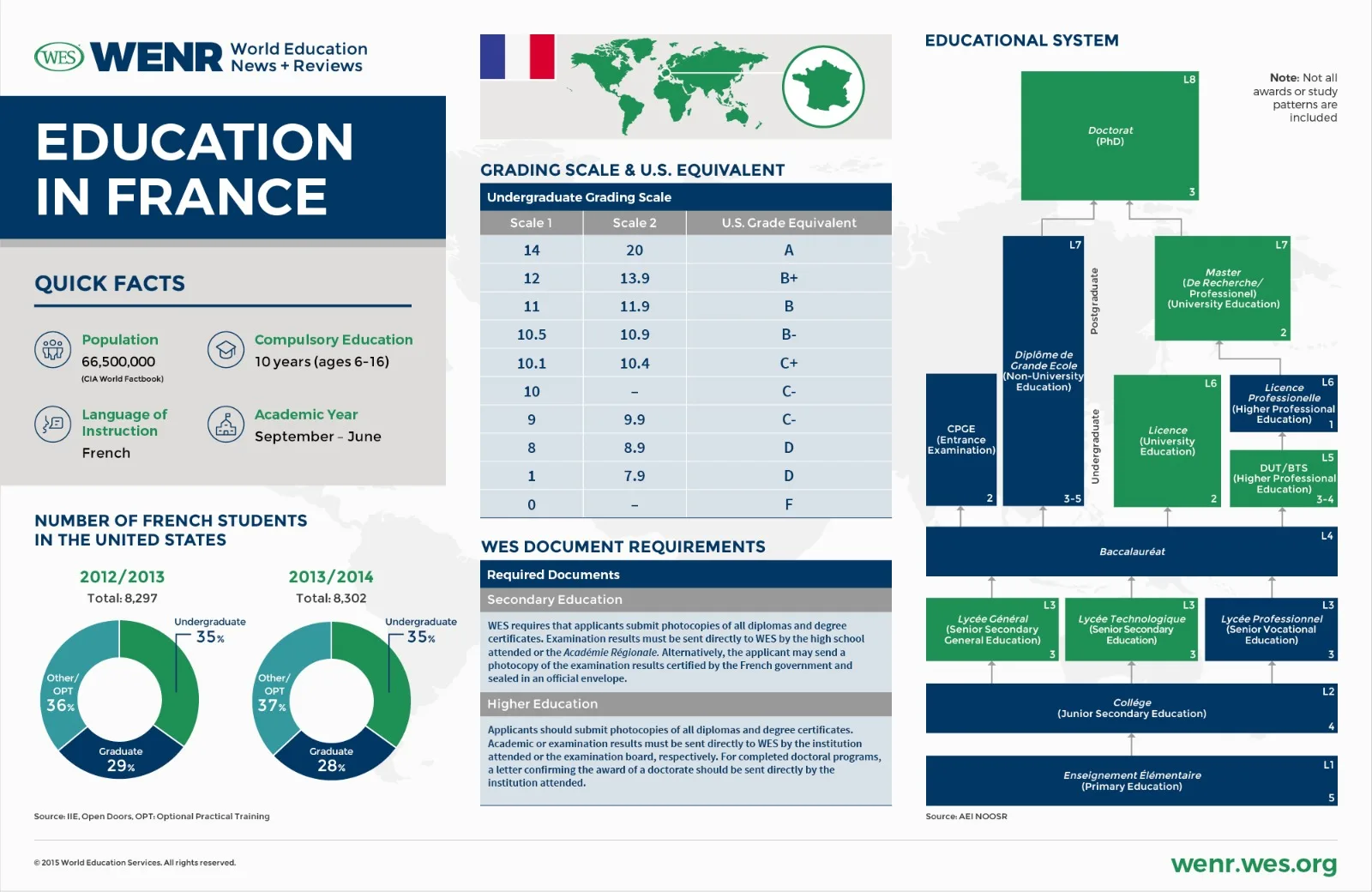
The French education system is characterised by a strong central State presence in the organisation and funding of Education. The French education system is regulated by the Department for National Education, Higher Education and Research. It governs within the framework defined by the Parliament, which states the fundamental principles of education. The State plays a major role in governance, as, by long tradition, the French education system is centralised. The State defines the details of curricula at all education levels; it organises the teachers' admissions procedure, defines content, recruits teachers who become civil servants, provides them with in-service training; it recruits and trains inspectors, responsible for controlling the quality of the education system; it is the main funding body of the public education system and subsidises "private schools under contract" which receive approximately 20% of school pupils.
Nevertheless, at local level, and since the start of a process of decentralisation of competences in the administration of the educational system in the 1980s, local authorities have been playing an increasingly significant part in governance, ensuring the material operation of the system (construction and maintenance of school buildings, school transport, supply of educational materials, etc.).
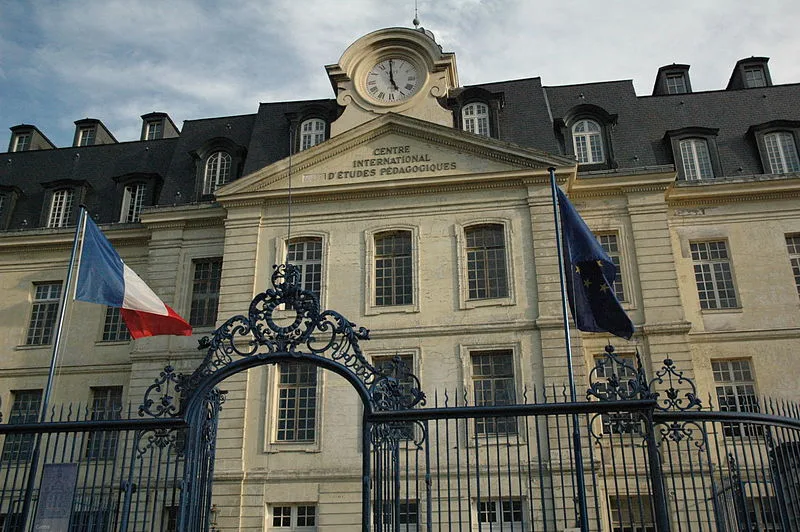
The official language for education is French. Public education is secular and free.
France has a long tradition of pre-primary education: for the past twenty years, almost all children have attended école maternelle (nursery school) from three to six, even though it is optional; it is therefore an integral part of the French education system and falls under the responsibility of the Department for National Education, Higher Education and Research, which sets the curricula.
French pupils are taught the same subjects until the age of 15 within a "collège unique" (ISCED 2). The first stage of specialisation occurs at the end of collège (lower secondary education): pupils are streamed to attend either a general, technological or vocational lycées. All prepare pupils to take the baccalauréat in three years, marking the end of secondary education: pupils who pass it obtain the State-issued baccalauréat diploma (general, technological or vocational) which opens up access to higher education and entitles them to enrol at university.
Higher education is characterised by the coexistence of two systems: universities, – public institutions that have an open admissions policy, except for Instituts Universitaires de Technologie (IUT - University institutes of technology) or some classes préparatoires intégrées (integrated preparatory classes) – and a non-university sector, including, in particular, Grandes Écoles (Elite Schools), with a highly selective admissions policy open to baccalauréat holders having attended two years of classes préparatoires, themselves highly selective on entry and during the course. Post-secondary non-tertiary education is marginal in France: the only two diplomas of ISCED 4 that the French education system provides combined amounted to less than 10,000 graduates in 2014.
In 2014, the French education system provided schooling for around 15.4 million pupils, students and apprentices (representing about 23% of the national population). All financing parties combined, the national community effort towards education activities was estimated to 146 billion euros the same year.
Stages of the Education System
Education is compulsory between the ages of 6 (which corresponds to the start of primary education) and 16 (which does not represent the end of a cycle).
- Pre-primary education (ISCED 02), which is dispensed at “nursery schools” and take children from 2/3 up to 6 years of age. Almost all children attend nursery school from the age of three, even though it is optional. Such schools therefore form – together with the elementary level - an integral part of the French “primary level of education”, which is under the supervision of the Department for National Education, Higher Education and Research.
- Primary education (ISCED 1), which is provided in “elementary schools” and admits children between the ages of 6 and 11. It marks the start of compulsory schooling, and is secular and free of charge when dispensed in State schools. At the end of this 5-year-course, pupils automatically access to the secondary level of education (there is neither standardised tests nor guidance procedures).
- Lower secondary education (ISCED 2), which is provided in collèges for 4 school years (pupils between 11 and 15). Education in collèges is compulsory and common to all pupils. The end of the lower secondary education is sanctioned by the Diplôme national du brevet (DNB); however, admission to upper secondary level is not conditional upon success in the DNB. At the end of collège, the school recommends the appropriate scholastic path to families, basing its recommendation on the pupil’s school reports and particular interests.
- Upper secondary education (ISCED 3), which is dispensed in “general and technological lycées” or in “professional lycées”, which extends over 3 years (pupils between the ages of 15 and 18 years). Upper secondary education provides three educational paths: general path (which prepares pupils for long-term higher studies), technological path (which mainly prepares pupils for higher technological studies) and professional path (which leads mainly to active working life, but also enables students to continue their studies in higher education). The end of upper secondary education is sanctioned by the baccalauréat, and access to higher studies is conditional to its obtention. Pupils at professional lycées can prepare the Certificat d’aptitude professionnelle (CAP – Professional aptitude certificate), a course of study extending over 2 years, after what they can either integrate active working life or prepare the professional baccalauréat in one year.
- Higher education (ISCED 5 to ISCED 8), which is dispensed in higher educational institutions. These institutions have a wide variety of legal statuses that are listed in the French Code of Education. There are two types of short cycles studies (Sections de Techniciens Supérieursand Diplôme Universitaire Technologique). Courses dispensed in French higher education institutions have different aims and conditions for admission, but most of them are structured into three study cycles (Bachelor’s degree, Master’s degree and Doctorate) and in ECTS credits, in compliance with the principles of the Bologna Process.
In Romania, educational system
- Has an open character, allowing the mobility of pupils, by transfer from a school unit to another school unit, from a class to another class, from a field of study to another field of study and from a pathway to another pathway.
- Has a pluralistic character (public or private schools, in educational alternative system) and it provides schooling methods in the official state language (the Romanian language), in the native languages of the pupils belonging to the national minorities or in languages of international circulation.
In Romania the education represents a national priority.
The national educational system includes authorized or certified public, private and confessional education units. The education institutions are managed by the local authorities.
The state ensures equal rights of access to all levels and forms of pre-university and higher education, as well as to lifelong learning, without any form of discrimination, to Romanian citizens, as well as to the citizens of the other European Union member states, of the states belonging to the European Economic Area and of the Swiss Confederation.
In Romania only the diplomas acknowledged by the Romanian state, according to the legislation in force, are available.
General mandatory education has 13 grades and includes the primary education, the lower secondary education and the upper secondary education.
Public-school education is free.
The forms of organization of the pre-university education are:
- frequency education - is mandatory education.
- reduced frequency education.
Stages of the Education System
The national education system includes the following levels:
- Early education (0—6 years):
- the before preschool level (0—3 years)
- the preschool education (3—6 years), which includes: the small group, the middle group and the big group. In public institutions it is free.
- Primary education (ISCED 1):
- the preparatory grade
- grades 1—4.
- Secondary education or gymnasium (ISCED 2)
- The upper secondary education (ISCED 3):
- high school education, which includes the high school grades 9-12/13, with the following pathways: theoretical, aptitude-based (vocational) and technological.
- a minimum 3-year professional education. The graduates of the professional education promoting the certification examination of the professional qualification may attend the high school education courses.
- The tertiary non-university education (ISCED 4)
- professional education
- technical education
- post-secondary education.
- The higher education (ISCED 5-8)
- Bachelor studies
- Master studies
- PhD studies.
Early childhood education - before preschool level can take place in nurseries, kindergartens and daycare centers, whether state-owned or private, according to the same educational content and the same national standards.
Preschool education takes place in kindergartens or schools (state or private), which have pre-school groups as a section, following the same curriculum and respecting the same national standards.
Early education is free in public institutions.
Secondary lower education or gymnasium includes grades 5—8. The access to the higher level is achieved by a national evaluation examination and distribution in upper secondary education units.
The tertiary non-university education includes the post-secondary education.
The professional and technical education is composed of:
Higher education is organized in universities, study academies, institutes, higher studies schools, referred to as higher education institutions or universities, temporarily authorized or certified. The high school graduates with high school diploma can enroll in the higher education. The admission conditions are different from one institution to another.
The structure of the higher education reflects the principles of the Bologna process:
JEAN DE LA FONTAINE High School
In 1280, 4 years before the Sorbonne, a college was built in what is now rue du Château, founded by Queen Blanche of Artois opposite the Hôtel-Dieu. He was immediately immensely successful: “The lessons there were free, the eagerness to attend this school was so great that we were soon obliged to hire several masters. ". Distractions and games were not forgotten, especially cockfights attracting many spectators.
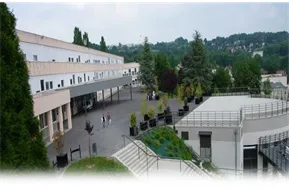
It was at the old college of Château-Thierry, then nicknamed Chaury, that Jean de La Fontaine began his studies. The fame of this college attracted young people almost as much as that of the universities of Paris and Rheims. It was probably also there that he met his friend François de Maucroix, a native of Noyon.
This college was abolished during the Revolution. In 1802, he was transferred to the Couvent des Cordeliers on the authorization of the First Consul, in the very street where the birthplace of the fabulist still stands.
This street was during this time called "Rue des collèges". In 1831, Louis-Philippe, on a visit to the city, lodged at the college and gave a dinner for 70 people there.
Then the college was transferred to the former Convent of the Capuchins (buildings from 1623) on the other bank of the Marne, where it remained first as a college (1st and 2nd cycles with primary school), then as a high school until 1974.
The name “Collège Jean de La Fontaine” had been given in 1889; the transfer took place in 1906. All the buildings, erected during different periods, formed a harmonious whole. From the two turrets located on either side of the entrance, you could see a magnificent park in which there was a statue of the sculptor Jacopin.
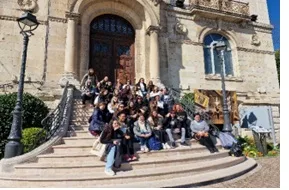
During the war of 1914-1918, the college was transformed into a hospital. The classes were dispersed everywhere: rue Jean de La Fontaine, avenue de Soissons, ...
In the 1920s and 1930s, many foreign students attended this establishment, especially young Chinese. Some were to become famous like Pa Kin, the writer nominated for the Nobel Prize. This tradition of hospitality lasted for many years: Asians, Africans, … or young Parisians enjoying the countryside; Among them too, there were famous people, especially in the entertainment world.
However, the old buildings of the Cordeliers were not abandoned: they housed a primary school and a higher primary school for young girls which became the Jean-Macé college. This establishment was independent and welcomed only girls from 6th to 3rd in its modern section and its secretarial courses. This independence lasted until 1959, when it was attached to that of the edges of the Marne on the educational level.
In 1974, many buildings were built on the avenue de Champagne to house the 2nd cycle and the professional sections: the La Fontaine high school changed location and educational structures. The old Capuchin buildings became the Collège Jean Racine.
1992: Renovation and extension of the high school buildings as part of a Picardy Region program. Inauguration by the President of the Regional Council and many personalities.
2007: New renovation and extension with creation of the belvedere including an amphitheater called “Espace Estruch” as well as a contemporary art gallery.
At the following links you can find more details about the life of students in high school, their curriculum and information related to baccalaureate exams: